




Blockchain and it uses beyond cryptocurrencies
“The true revolution of blockchain comes from the fact that, through its network, we can transfer assets”.
Blockchain has consolidated its status as one of the most disruptive technologies of recent years, even drawing comparisons with the revolution that the Internet represented for the world of communications. Why is this? What is blockchain and what benefits can it give companies? The Blockchain Project Manager at Banco Santander, Paula Pascual Cortés, gave an overview in her recent web conference entitled “Blockchain: its uses beyond cryptocurrencies”.
Are you ready to embrace the disruption? Let’s go for it!
What is Blockchain?
Pascual explained that networks used to be centralized: they had a central server. In the event of a failure, all communication was lost. Then, with the arrival of the Internet, distributed networks appeared. Therefore, communication no longer depended on a single server, but rather several of them. The story is the same in blockchain, we have a distributed decentralized network.
The Internet of Information Vs. The Internet of Value
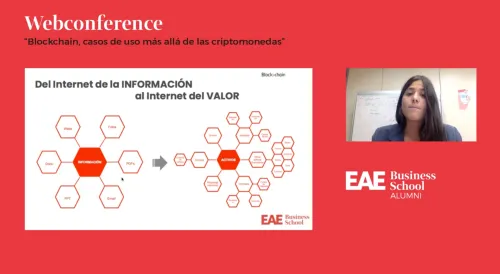
Continuing with the definition, the expert emphasized that the true revolution of blockchain comes from the fact that we can transfer assets through its network. “It is no longer a matter of just sending copies of the files as we currently do on the Internet”, she explained.
For a more in-depth explanation, she gave an example: “When we send a photograph by email, we send a copy of the photograph that is saved on our computer. So, what happens if we want to send an element of value, such as money or shares?”. That is where the blockchain network comes into play, as it lets us send value that is automatically deducted from our balance and added to the balance of the person who we are sending it to.
It is important to understand that this value is kept safe in trusted institutions like banks, and the records and databases they operate. In this process, the Internet is simply a layer of communication, explained Pascual.
The current problem is that the databases are not shared between banks due to a lack of trust. Therefore, to carry out transactions between them, lots of intermediaries are needed in the process, such as payment processors and clearing houses. This is where blockchain comes in to revolutionize the world of transactions and provide a new means of exchange.
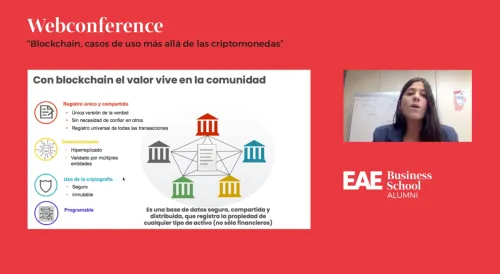
“The real value of blockchain comes from the technology and the cryptography it uses to reach a consensus between the parties”, explained the expert. Rather than each of the parties involved having different information, which hinders and slows down all kinds of transactions, blockchain enables the generation of a universal database that, as well as being secure, updates automatically after every transaction. This ensures that both financial institutions and companies and all the stakeholders can have information that is always up to date.
Decentralization
To understand the world of blockchain, it is essential to grasp the concept of decentralization. Pascual emphasized that “decentralization is the key to blockchain technology, because there is no intermediary who oversees it all and also charges us a fee for their service. In the end, each party has their database that, in turn, is connected to their blockchain network, and the transactions are validated between the parties themselves, with no need for a central body”.
Cryptography
Another key aspect is cryptography, the feature that makes blockchain one of the securest technologies currently available. “Besides making it secure, cryptography makes blockchain immutable and programmable”.
Therefore, blockchain is a secure database that is distributed and shared between various parties. The aim of all this is to record and enable transactions of any type of asset, not only financial instruments, but also real estate, entities, contacts and much more.
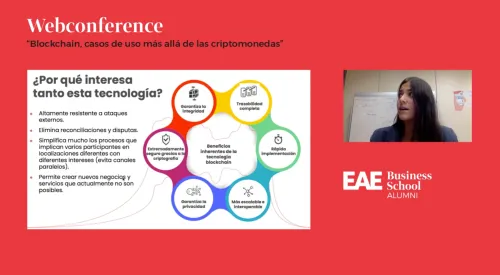
Public Blockchain Vs. Business Blockchain
Moreover, there are different types of blockchain networks, such as public and business networks. Public blockchain networks are open, such as Bitcoin, in which there is a great degree of confidence and anybody can enter and take part. In contrast, in the case of blockchain networks, such as Banco Santander, the participants have to be approved and cryptocurrencies are not used.
Applications in companies
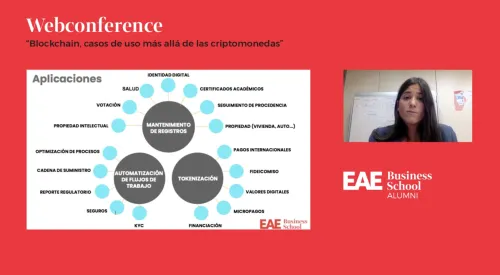
So, how is blockchain technology used in companies nowadays? Pascual Cortés outlined 3 main categories: Record-keeping, workflow automation and tokenization. Let’s find out more:
Record-keeping:
- Votes: Companies are testing out this technology to start using in national votes. However, this is still at the research stage because there are certain problems in this respect, including a lack of digital identities that ensure that the people voting are really who they say they are.
- Academic certificates: Likewise, blockchain networks can also be used to ensure that academic certificates are not falsified or modified, as they will be 100% secure once they are inside the blockchain network.
- Origin tracking: All aspects of origin denomination is another issue that can be managed very efficiently using blockchain network.
- Property: Likewise, blockchain can be used for anything to do with exchanging and transactions with properties, such as houses and cars, among other things.
Workflow Automation:
- Supply chains: Blockchain technology can also be used to optimize processes and connect all the information required by all the participants in the supply chain in a single database. In this case, we can also use smart contracts.
What are Smart Contracts?
Smart Contracts are computer programs or lines of code that we embed in a blockchain and which automatically execute in a distributed way. For instance, is somebody sends oranges from Italy to Spain, a smart contract could automate certain rules: I want to put sensors on the containers to ensure that the temperature that they are shipped at is optimal. If this criterion is not met, the seller has to pay a penalty because the oranges will not are in good condition.
Tokenization:
Tokenization is the representation of a value in the real physical world but in a digital format in a blockchain network. We can tokenize anything we want to. I can tokenize my house and, once I have represented it as a token in the digital world, I can trade it with this blockchain without having to rely on third parties or intermediaries such as notaries, etc.
This can be taken even further. I could tokenize the house into 1,000 tokens, with each token representing a percentage of the profit that I will generate from the house, by renting it out, for example. As a result, through the blockchain network and with the help of smart contracts, the money that is collected every month is shared out directly among the people holding the tokens.
Tokenization is used a lot for international payments, trusts, bonds, micropayments and all aspects of finance.
As we can see, blockchain technology opens up an endless spectrum of possibilities for the business world. Tokenization, automation and all aspects of keeping records are just a small part of everything that this trend may eventually be used for. However, it should be noted that this is a technology in progress, so it is still expensive and subject to errors.
So, did you know everything that blockchain has to offer you?