




"In the deceleration phase, there is a moderate slowdown in the growth of sales, production and investment"
When making business decisions, it is important to have a diverse range of financial knowledge that is used on a daily basis.
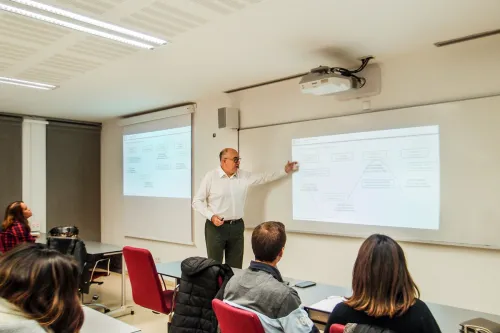
This was the topic of the latest edition of the Focused Program held at the Barcelona Campus of EAE Business School, entitled "Interpreting financial information to make strategic decisions", run by Martí Pachamé, a lecturer on the School's MBA, EMBA and IMBA programs.
It is crucial to have a grasp of concepts such as balance sheets and profitability, GDP, the working population survey, IPI, public deficit and many more indicators in order to make all kinds of decisions. According to the lecturer, one of the characteristics of the phases of the economic cycle is the expansion phase, "in which there is strong and sustainable GDP growth. In recent years, the rates were around 3%. It is currently about 2.5% because there is a certain level of stagnation". In the deceleration phase, there is a moderate slowdown in the growth of sales, production and investment.
He went on to describe the recession phase, in which GDP contracts, along with significant reductions in production and investment. Lastly, in the recovery phase, there is a low level of growth in activity "with indication of improvements in consumption".
Next, he presented the idea of profitability as a measurable concept and, with this in mind, we have to take four factors into account: the profit made, the amount of capital required, how long since the investment was analysed and the risk. In addition, the lecturer discussed the Working Population Survey, which gives us more clues for analysing the company's economic structures. According to Pachamé, unemployment has decreased gradually.
Other analytical indicators include the CESI, with rising steel prices, and the Purchasing Managers' Index, a macroeconomic indicator that aims to reflect a country's economic situation based on data gathered in a monthly survey completed by the Purchasing Managers of the most representative companies. "There is currently lower demand for products and so people are buying less".
It is also important to measure the growth activity of emerging countries, inflation and the raw materials index, the production price indexes and the IPI. Martí Pachamé also explained the concept of public debt, acknowledging that the current debt crisis (Spain, Greece and Italy) should be on the decrease), adding that China is also in debt, but it is a matter of company indebtedness rather than public debt.
Furthermore, he emphasized that both the Brexit announcement in 2016 and the election of Trump had impacts on the financial markets. The EAE lecturer also highlighted some of the current headlines that influence the markets and company decisions: this year's sanctions on Russia and the trade war between the USA and China.
He concluded the session by stating that decisions are made more quickly nowadays and this increases the risk involved. "As such, they should be really profitable and that is not the reality of the situation. This create a higher level of uncertainty, despite having access to more information".