




Report “Young Talent: The Career Motivations of Millennials and Generation Z. Focus on Peru”, prepared by EAE Business School
- The myth of Generation Z’s job instability is crumbling: 76% of young people aim to stay at least two years in the same company, demonstrating a commitment to stability that contradicts their reputation for inconsistency.
- The report also reveals that for many young people, work is not their primary life project, and only a portion see the professional sphere as a central space for personal fulfillment.
- LinkedIn has established itself as the main job search tool (95%), although networking activities continue to play a significant role (64%).
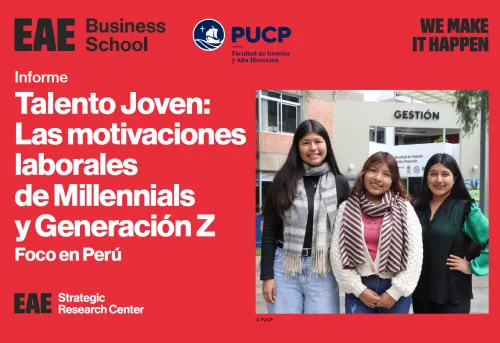
The latest report, Young Talent: The Career Motivations of Millennials and Generation Z, prepared by EAE Business School, part of the higher education network Planeta Formación y Universidades, in collaboration with the Pontificia Universidad Católica del Perú (PUCP), reveals a profound shift in young people’s relationship with work: 76.5% of respondents state that they are interested in staying more than two years in the same company, breaking the myth of the “inconsistent young worker” historically attributed to Generation Z, which links frequent job changes to a supposed lack of commitment.
“We are not facing an uncommitted generation, but rather young people who are willing to stay when they perceive real opportunities for growth, learning, and alignment between what the company promises and what it actually offers,” says Miriam Diez Piñol, Director of the Master’s in Human Resources at EAE Business School.
The report also reveals that among the 45% of young people currently working, 35% do so mainly to cover expenses and hobbies, while only 27% identify employment as a space for self-fulfillment.
“For many young people, employment is no longer their main life project, and only a portion find personal fulfillment in the workplace,” explains Diez Piñol.
LINKEDIN, THE MAIN JOB SEARCH TOOL
The study also shows that LinkedIn has consolidated its position as the primary job search tool: 95% of young people use it as their main channel. Nevertheless, networking remains significant, with 64% turning to professional contacts and 29% to family contacts to access job opportunities.
However, nearly half of young people (47%) believe that companies do not fully understand their core priorities. These include the need for personal time, flexibility, and ethical, transparent, and collaborative leadership.
“Organizations continue to focus almost exclusively on compensation, whereas for young talent the balance between salary, flexibility, and leadership quality is decisive,” notes Esther González Arnedo, Director of the Master’s in Human Resources at EAE Business School.
The report shows that young people accept a job when the financial offer is fair, but decide to stay because of flexible hours, a positive work environment, and real opportunities for professional development. Conversely, they leave when salaries fall below expectations or when the internal environment deteriorates—and would only return if those three pillars are corrected: compensation, flexibility, and leadership.
LIFE BEYOND WORK
This emphasis on life beyond work is also reflected in other life decisions. 25.4% of the young people surveyed say they have taken a sabbatical period, while 35.7% have chosen to explore alternative paths such as entrepreneurship.
“It is not a rejection of work, but an active search for meaning, well-being, and coherence between personal and professional life,” González Arnedo clarifies.
Meanwhile, Paloma Martínez-Hague and María Isabel Cigüeñas, Peruvian researchers from PUCP who participated in the study, highlight that the findings demonstrate the existence of committed young Peruvian talent eager for job stability when offered real growth opportunities, flexibility, and ethical leadership.
“These findings allow organizations to optimize talent management by prioritizing not only retention through fair salaries, but also work-life balance and development opportunities, correcting the current mismatch perceived by 47% of young people,” they explain.
“The report outlines the profile of a more aware and demanding generation that is redefining the value of employment and challenging companies to adapt their organizational models to attract and retain Millennial and Generation Z talent in a labor market undergoing profound transformation,” the experts conclude.